
Polymer Concrete Market to Reach USD 778.88 Million by 2030, Driven by Infrastructure Upgrades & Chemical-Resistant Applications | Mordor Intelligence
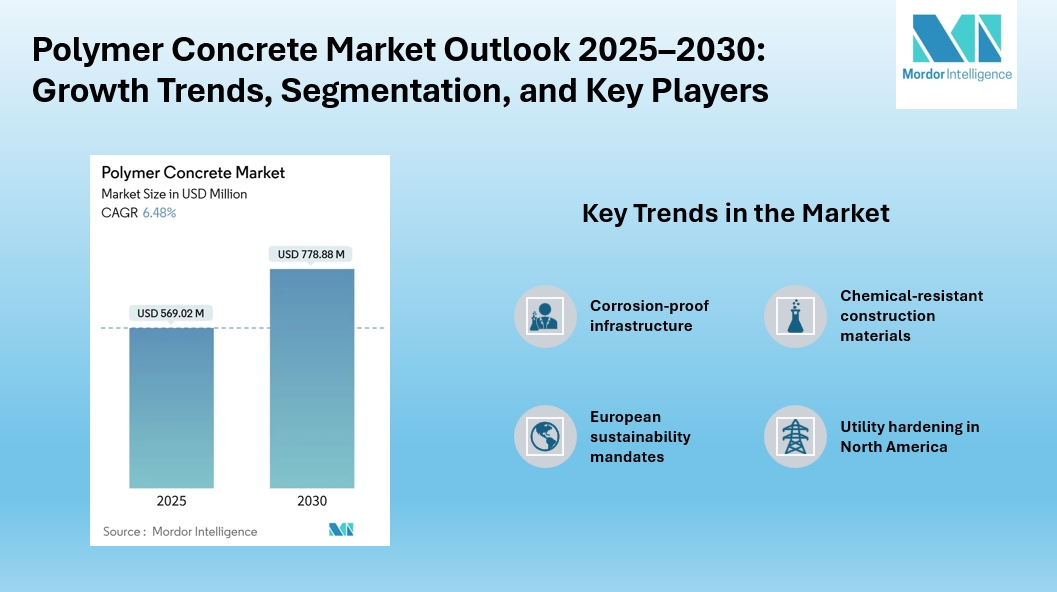
According to Mordor Intelligence, the polymer concrete market size is projected to grow from USD 569.02 million in 2025 to USD 778.88 million by 2030, reflecting a 6.48% CAGR. Polymer concrete, which replaces Portland cement with synthetic or natural resins, offers superior compressive strength, faster curing times, and enhanced resistance to chemicals and environmental stressors.
The demand is being reinforced by rapid urbanization in Asia-Pacific, stricter sustainability mandates in Europe, and the growing need for non-conductive materials in North American utility networks.
Polymer Concrete Key Trends
Corrosion-proof infrastructure:
Utilities and governments are increasingly replacing steel-reinforced concrete with epoxy-bound polymer concrete in sewage systems and desalination plants. This shift is driven by the material’s ability to retain up to 90% of its strength even under prolonged exposure to acids and salts.
Chemical-resistant construction materials:
Industrial hubs in China, South Korea, Germany, and the U.S. Gulf Coast are adopting polymer concrete for tank plinths, containment areas, and loading bays. The lifecycle savings from reduced shutdowns and thinner wall sections are proving attractive to chemical processors.
European sustainability mandates:
The European Chemicals Agency’s ban on intentionally added micro-plastics has accelerated the adoption of epoxy-based overlays with low permeability. These overlays have demonstrated longer service lives compared to asphalt alternatives, making them a preferred choice for road projects.
Utility hardening in North America:
Storm-related outages have prompted U.S. utilities to adopt non-conductive polymer concrete pads for transformers and switchgear. These pads provide insulation, durability, and resistance to freeze-thaw cycles.
Data-center drainage systems:
The rise of prefabricated polymer concrete drainage channels in data-center construction highlights the material’s role in modern infrastructure. Quick installation and low maintenance are key benefits for facility managers.
Explore In-Depth Insights and Regional Perspectives, Including Localized Editions such as the Japan Market: https://www.mordorintelligence.com/ja/industry-reports/polymer-concrete-market?utm_source=abnewswire
Polymer Concrete Segmentation
By Polymer Type
- Epoxy: Leading with over 50% share, epoxy-based polymer concrete is favored for its bond strength and acid resistance.
- Polyester: Used in cost-sensitive projects but limited by compressive strength.
- Methyl Methacrylate: Preferred for rapid-set repairs, especially in airports.
- Others: Acrylate and latex systems serve niche applications requiring flexibility.
By Binding Agent
- Synthetic Resin: Dominates with 80% share due to proven field performance.
- Natural Resin: Expected to grow fastest (7.56% CAGR) as bio-based alternatives gain traction, particularly in Europe and Japan.
By Application
- Asphalt Pavement Overlays: Account for nearly 40% of revenue, benefiting from fast curing and traffic reopening.
- Industrial Tanks: Forecast to grow at 6.99% CAGR, driven by chemical containment needs.
- Prefabricated Drainage Systems: Expanding in data-center and urban infrastructure projects.
- Building Maintenance: Used in overlays for hospitals, warehouses, and commercial facilities.
- Specialty Uses: Includes outdoor furniture, façade panels, and countertops.
By End-User Industry
- Infrastructure: Largest segment, contributing nearly half of revenue, with focus on long service life and reduced maintenance.
- Industrial: Fastest-growing segment (7.34% CAGR), supported by chemical, mining, and semiconductor industries.
- Commercial: Adoption in retail and sports facilities for aesthetics and slip resistance.
- Residential: Niche applications in terraces, designer furniture, and premium countertops.
By Geography
- Asia-Pacific: Largest and fastest-growing region, accounting for 41.5% of sales in 2024. Growth is supported by China’s Belt and Road projects and India’s smart-city initiatives.
- North America: Steady demand from infrastructure investment programs.
- Europe: Driven by sustainability regulations and preference for durable overlays.
- Middle East & Africa: Rising demand in desalination plants and district cooling systems.
- South America: Growth centered on Brazil’s port expansions and mining projects.
Explore Competitive Landscape Details: https://www.mordorintelligence.com/industry-reports/polymer-concrete-market/companies?utm_source=abnewswire
Top 5 Key Players Analysis
BASF SE – Known for advanced resin formulations and global supply capabilities.
Sika AG – Strengthened its North American portfolio through the acquisition of Kwik Bond Polymers in 2024.
ACO Ahlmann SE & Co. KG – Focused on drainage systems and infrastructure solutions.
Mapei S.p.A. – Offers a wide range of construction chemicals, including polymer concrete systems.
Wacker Chemie AG – Active in specialty chemicals and polymer-based construction materials.
Conclusion
adoption is being fueled by infrastructure upgrades, industrial containment needs, and sustainability-driven regulations. Asia-Pacific will remain the largest and fastest-growing region, while Europe and North America continue to provide steady demand through regulatory and utility-driven projects.
As industries seek materials that combine durability, chemical resistance, and cost efficiency, polymer concrete is emerging as a reliable choice. With ongoing research into bio-based binders and specialized applications, the market is set to expand its footprint across diverse sectors.
Explore Chemicals & Materials Research Details: https://www.mordorintelligence.com/market-analysis/chemicals-materials?utm_source=abnewswire
About Mordor Intelligence
Mordor Intelligence is a trusted partner for businesses seeking comprehensive and actionable market intelligence. Our global reach, expert team, and tailored solutions empower organizations and individuals to make informed decisions, navigate complex markets, and achieve their strategic goals. With a team of over 550 domain experts and on-ground specialists spanning 150+ countries, Mordor Intelligence possesses a unique understanding of the global business landscape. This expertise translates into comprehensive syndicated and custom research reports covering a wide spectrum of industries, including aerospace & defense, agriculture, animal nutrition and wellness, automation, automotive, chemicals & materials, consumer goods & services, electronics, energy & power, financial services, food & beverages, healthcare, hospitality & tourism, information & communications technology, investment opportunities, and logistics.
For any inquiries, please contact:
https://www.mordorintelligence.com/contact-us
Media Contact
Company Name: Mordor Intelligence Private Limited
Contact Person: Jignesh Thakkar
Email: Send Email
Phone: +1 617-765-2493
Address:11th Floor, Rajapushpa Summit, Nanakramguda Rd, Financial District, Gachibowli
City: Hyderabad
State: Telangana 500008
Country: India
Website: https://www.mordorintelligence.com/industry-reports/polymer-concrete-market


