
Oakland County License Restoration Lawyer Paul J. Tafelski Discusses Common Mistakes in License Restoration Hearings
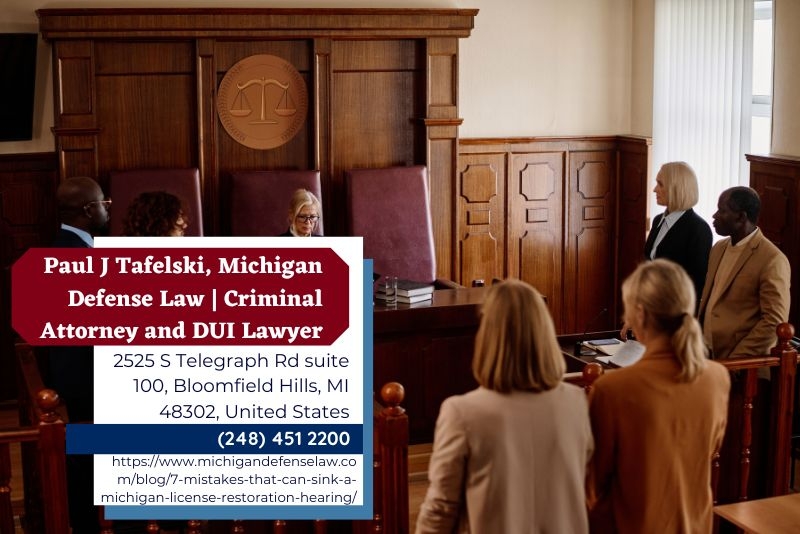
In Michigan, the path to restoring a suspended driver’s license is often far more difficult than people expect. Oakland County license restoration lawyer Paul J. Tafelski of Michigan Defense Law (https://www.michigandefenselaw.com/blog/7-mistakes-that-can-sink-a-michigan-license-restoration-hearing/) is drawing attention to the most common mistakes that applicants make during the restoration process, and how to avoid them. “People often think it’s just about explaining why they need to drive again,” said Tafelski. “But the hearing is not about hardship. It’s about proving to the state that they are no longer a risk to public safety.”
With years of experience helping clients regain their driving privileges, Oakland County license restoration lawyer Paul J. Tafelski warns that a poorly prepared application can lead to a denial, forcing individuals to wait another full year before they can reapply. For many, that means another year of relying on friends, public transportation, or costly rideshare services.
What sets the Michigan license restoration process apart, according to Oakland County license restoration lawyer Paul J. Tafelski, is the strict legal standard applicants must meet: clear and convincing evidence. This standard requires applicants to do more than simply claim they’ve stopped using alcohol or drugs; they must present consistent, credible documentation that shows their substance use is under control and will likely remain so.
“Statements like ‘I don’t drink anymore’ won’t cut it,” Tafelski explained. Documented sobriety, detailed support letters, and a thorough recovery plan. Everything has to line up, and even a small inconsistency can be enough for the hearing officer to issue a denial.
One of the most critical components of a successful case is the Substance Abuse Evaluation (SAE). This report must be completed by a licensed counselor who understands the license restoration process. Tafelski warns that even well-meaning applicants often select evaluators who don’t understand Michigan’s specific requirements, leading to incomplete or inconsistent reports that derail the case before it even reaches a hearing.
Another often misunderstood element is the support letters. These letters, typically from family members, friends, employers, or others familiar with the applicant’s sobriety, are not just character references; they are legal evidence. Letters that lack full contact information, omit the sobriety date, or offer vague details can raise red flags with hearing officers.
Tafelski emphasizes the importance of honesty and self-awareness during the hearing itself. A solid application can still fall apart if the applicant appears defensive, evasive, or unprepared during questioning. “This is not a casual conversation; it’s a formal legal proceeding,” Tafelski noted. “What you say, how you say it, and your overall attitude all play a role in the officer’s decision.”
Many applicants also make the mistake of thinking that being sober is enough. According to Tafelski, applicants must also show that they are actively maintaining their sobriety through a program of recovery, whether that’s Alcoholics Anonymous, therapy, SMART Recovery, or a structured personal plan. Hearing officers want to see that sobriety is more than a temporary change; it must be a lifelong commitment backed by consistent actions.
Even after a successful hearing, Tafelski warns that the process isn’t over. Applicants are granted a restricted license with an ignition interlock requirement, and any violations during this period, such as missed rolling re-tests or positive alcohol readings, can result in immediate revocation.
“People think winning the hearing is the finish line, but it’s really just the start of the final phase,” he said. “The ignition interlock period is a real-world test of whether the person is ready to drive safely and legally.”
The most damaging mistake, according to Tafelski, is trying to go through the process without legal representation. “The data shows that people who go it alone are far more likely to be denied. There are just too many small details that can trip a person up.”
He also points out that many people rely too heavily on the Secretary of State’s materials, assuming that the standard packets are enough. “The basic forms don’t prepare a person for the legal scrutiny of a hearing,” said Tafelski. “It’s not about doing the bare minimum, it’s about building a complete, convincing case.”
Applicants who are denied often face lasting consequences. Not only must they wait another full year to reapply, but the denial becomes part of their permanent record, making future hearings even more difficult.
For those ready to restore their driving privileges, Paul J. Tafelski urges applicants to treat the process with the seriousness it deserves. “This is the chance to show the state that their life has changed,” he said. “If they treat it casually or make avoidable mistakes, they may lose that chance for another year.”
Paul J. Tafelski and the team at Michigan Defense Law offer legal support for those navigating the license restoration process in Oakland County and across Michigan. From preparing the SAE and support letters to coaching clients for their hearings, Tafelski’s approach is focused on helping clients avoid the common pitfalls that lead to denials.
Getting a driver’s license back in Michigan is a complicated legal process that demands preparation, consistency, and honesty at every stage. Anyone serious about restoring their independence through driving should take the process seriously and consider working with an attorney who understands the rules and knows how to build a winning case.
For those seeking guidance through Michigan’s license restoration process, Michigan Defense Law encourages individuals to take the first step toward regaining their driving privileges. Every case is different, but the pathway to success begins with preparation and professional support.
About Michigan Defense Law:
Michigan Defense Law provides legal services to individuals dealing with criminal defense matters throughout Michigan. Led by attorney Paul J. Tafelski, the firm handles a variety of legal issues, including license restoration cases, with a focus on thorough preparation and strong advocacy.
Embed:
GMB: https://www.google.com/maps?cid=7441820969606749572
Email and website
Email: [email protected]
Website: https://www.michigandefenselaw.com/
Media Contact
Company Name: Michigan Defense Law
Contact Person: Paul J. Tafelski
Email: Send Email
Phone: (248) 451-2200
Address:2525 S Telegraph Rd suite 100
City: Bloomfield Hills
State: Michigan 48302
Country: United States
Website: https://www.michigandefenselaw.com/


