
Bathroom Remodeling in Gilbert Starts with Decisions About Layout, Waterproofing, and Storage
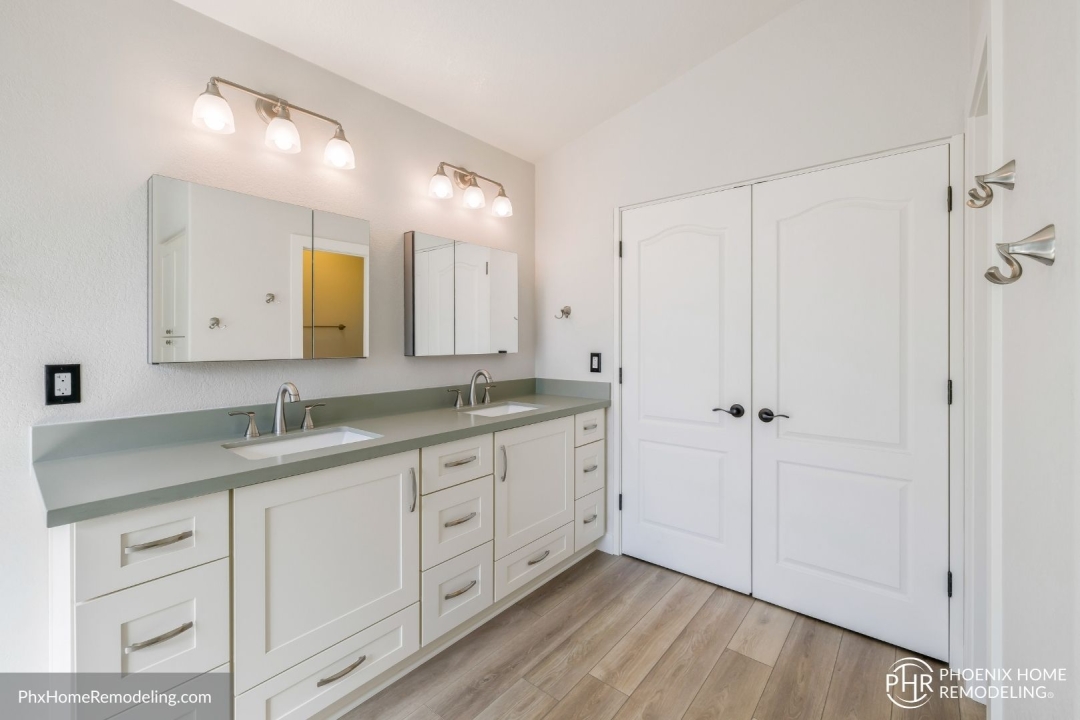
March 10, 2026 – Across Gilbert, many bathrooms still reflect the original layouts that came with homes built during the area’s major growth years. Large corner tubs that rarely get used, enclosed shower spaces that feel tight, vanities with limited drawer storage, and lighting plans built around a single overhead fixture are common conditions. Many Gilbert neighborhoods developed in the late 1990s and early 2000s still contains these original configurations. As more homeowners stay in place longer and adapt their homes around changing routines, bathroom remodeling is increasingly being approached as a planning exercise, not just a finish update.
Bathroom remodeling in Gilbert often looks simple at first glance. A homeowner may want a larger shower, better storage, updated tile, or improved lighting. But in a bathroom, those choices connect directly to plumbing locations, framing adjustments, waterproofing details, ventilation, cabinetry dimensions, and trade sequencing. Because so many systems are concentrated in one compact room, the quality of the planning phase has a direct effect on whether the project moves forward in an orderly way or requires revisions after construction starts. Phoenix Home Remodeling, a Phoenix-based design-build remodeling company, recently outlined several project-type planning considerations that Gilbert homeowners should define before demolition begins.
Phoenix Home Remodeling, a Phoenix-based design-build remodeling company, recently outlined several project-type planning considerations that Gilbert homeowners should define before demolition begins.
Layout decisions affect more than appearances
One of the most common requests in Gilbert bathroom remodels is replacing an underused bathtub with a larger walk-in shower. Another is reworking a vanity area so the room functions better for two people at the same time. Both goals sound straightforward, but both can trigger a chain of technical decisions that need to be resolved early.
In many Gilbert homes, the original bathroom footprint can be improved without increasing square footage. But even modest layout changes can influence how the room is framed, where plumbing lands, how glass is sized, and whether cabinetry will fit the way the homeowner expects. In homes built on slab foundations, drain location becomes a particularly important planning item. If the centerline of the new shower does not align with the existing plumbing, the floor work and shower dimensions need to be coordinated before tile selections and glass measurements are finalized.
That early evaluation typically includes questions such as:
- Will the drain remain in place or need to move?
- Does the new shower footprint allow for comfortable entry and door swing clearance?
- Will the vanity gain usable drawers, or only wider cabinet boxes?
- Where should shower controls be placed so the space works comfortably day to day?
- Is there enough wall area for niches, mirrors, sconces, or linen storage?
- These are not just drafting questions. They affect how the room functions once the remodel is complete.
Primary bathrooms and guest bathrooms also need different planning logic. A primary bath usually has more daily-use pressure placed on storage, lighting, and circulation. A guest bath may have a smaller footprint and tighter wall conditions, but still needs strong moisture management and efficient use of every inch. Homeowners who treat both rooms the same during planning often find that one of them ends up underperforming.
Another issue that shows up frequently in Gilbert remodels is the relationship between shower size and vanity size. Homeowners sometimes enter the process focused heavily on making the shower larger, only to realize later that the new footprint reduces storage or disrupts circulation at the vanity. When layout decisions are tested before construction, these tradeoffs can be evaluated in a more practical way.
Waterproofing, ventilation, and wall conditions should be resolved before tile is selected
Bathrooms are finish-heavy rooms visually, but their long-term performance depends on what is happening behind the surface. That is especially true inside the shower assembly, where waterproofing details are much more important than the tile itself.
A shower should be planned as a complete system. That means the framing, plumbing, slope, waterproofing method, drain location, and tile layout all need to work together. If those elements are decided in isolation, the room can look complete on a drawing but still become harder to build correctly once work begins.
Gilbert homeowners often focus on tile selections early, which is understandable because tile becomes one of the most visible decisions in the room. But tile size, pattern, and termination points all interact with technical details. A full-height tile wall, a recessed niche, a shower bench, or a window inside the wet area each adds coordination requirements that should be addressed before material quantities and installation plans are finalized.
For homeowners evaluating bathroom remodeling in Gilbert, this resource covers the broader planning process in more detail:
https://phxhomeremodeling.com/services/bathroom-remodel/
A few examples illustrate why sequencing matters:
- If the shower includes a window, the team has to determine early how the waterproofed assembly will return into that opening.
- If a homeowner wants a larger format wall tile, niche sizing and grout line alignment should be coordinated before installation begins.
- If the tile is intended to run to the ceiling, that affects measurements, material quantities, and visual alignment with nearby features.
- If new sconces, mirrors, or medicine cabinets are part of the remodel, the electrical layout should be coordinated with stud locations and final vanity dimensions.
Ventilation is another planning item that does not get as much attention as it should. Older bathroom configurations may rely on undersized fans or vent routing that no longer matches how the room is used. During a remodel, this is the time to review whether the room needs improved exhaust performance, revised fan placement, or updated moisture-resistant finishes around high-humidity zones.
Lighting works the same way. Many older bathrooms were designed around a center ceiling light with limited task lighting at the mirror. That may be sufficient on paper, but it often underperforms in practice. A better lighting plan usually combines general illumination with mirror-area lighting and a layout that supports morning and evening use more comfortably. When lighting is considered late, fixture placement can end up dictated by existing conditions instead of the final design intent.
Selections, storage, and coordination determine how smooth construction feels
One reason bathroom remodeling can become reactive is that homeowners often make the most visible decisions first and the functional ones later. Tile, fixtures, and paint colors are important, but storage planning, cabinetry configuration, and exact fixture placement are what turn a remodeled bathroom into a room that works well every day.
In Gilbert homes, vanity storage is often one of the most underperforming parts of the original bathroom. A vanity may look large from the outside but offer very little organized drawer space inside. During remodeling, it is worth defining whether the goal is more countertop area, more concealed storage, easier access to daily-use items, or a better balance of all three. That choice affects cabinet depth, drawer configuration, outlet placement, mirror width, and even walking clearance.
Selections also affect sequencing. A vanity cannot be finalized well if the plumbing locations are still vague. Mirror and lighting placement should not be left loose if cabinet dimensions are already ordered. Shower glass sizing becomes more predictable when curb details, tile thickness, and wall conditions are resolved before field measurement.
A planning-first approach helps reduce that rework by finalizing the following items before demolition begins:
- Confirmed layout dimensions
- Plumbing fixture locations
- Cabinet sizes and storage configuration
- Lighting and electrical positions
- Tile selections and installation pattern
- Waterproofing approach and shower details
- Major finish selections that influence lead times and coordination
When those decisions are completed in advance, trade sequencing becomes more predictable. Plumbers, electricians, tile installers, cabinet installers, and glass providers can each work from a clearer plan. That tends to reduce the need for mid-project redesign or product substitution.
Homeowners also benefit from having realistic cost ranges tied to actual scope rather than rough assumptions. Based on Phoenix Home Remodeling’s planning guidance, common bathroom renovation ranges include:
Primary bathroom remodel:
- Standard range: $40,000 to $60,000
- Larger or higher-spec range: $50,000 to $75,000
- Typical construction timeline: 4 to 7 weeks depending on scope
- Guest bathroom remodel:
- Full remodel: $18,000 to $25,000
- Bathtub to shower conversion: $15,000 to $17,000
- Typical construction timeline: 2 to 4 weeks depending on scope
These ranges are most useful when homeowners treat them as planning references, not final numbers. Room size, layout changes, shower size, vanity cabinetry, fixture choices, and finish selections all influence the final scope. That is why detailed planning usually comes before confirmed construction pricing in a design-build process.
Another factor homeowners should account for is the emotional side of daily-use rooms. Bathrooms are used under time pressure, often at the start and end of the day. Small layout frustrations become repeated frustrations when they happen every day. A vanity drawer that does not open comfortably, a shower entrance that feels cramped, or mirror lighting that creates shadows may sound minor during planning, but those details shape how the space performs long after construction ends.
That is why project-type planning matters so much in a bathroom remodel. The room has to be designed for routine, not just appearance. When layout, waterproofing, ventilation, lighting, and storage are treated as one coordinated system, the result is not only more buildable, but more functional for the homeowner after completion.
Third-Party Validation and Recognition:
- Rated #1 out of 59 general contractors in Gilbert, Arizona by Contractor Lists HQ
- Rated #1 out of 106 bathroom remodeling companies in Arizona by Contractor Lists HQ
- Featured Among Arizona’s Best Bathroom Remodeling Contractors by Home Builder Digest
- Awarded Best of Houzz – Service (2020–2026)
- Named a Top Contractor in Arizona by Ranking Arizona (2024)
- BBB Accredited Business, A+ rating
- 4.9 rating with 200+ public reviews across major platforms
View Phoenix Home Remodeling on Google:
https://goo.gl/maps/U6tzxTBVeuSbyJ7Y7
How to get to Phoenix Home Remodeling:
https://maps.app.goo.gl/cQJQhupEjPDuGQRN6
See the related post on Facebook:
https://www.facebook.com/PhoenixHomeRemodelingCompany/posts/who-is-the-best-bathroom-remodeling-contractor-in-gilbertbathroom-remodeling-in-/1347403270766395/
Related Phoenix Home Remodeling post on X:
https://x.com/phxhmremodeling/status/2029603519460954320?s=46
About Phoenix Home Remodeling:
Phoenix Home Remodeling is a Phoenix-based design-build remodeling company specializing in whole home, kitchen, bathroom, shower, and interior renovations.
The company uses a planning-first process that completes feasibility, material selections, and 3D design before construction begins. Fixed construction pricing is provided only after full planning and design are finalized to reduce surprises and change orders.
Phoenix Home Remodeling serves homeowners throughout Phoenix, Chandler, Gilbert, Scottsdale, Ahwatukee, Mesa, Queen Creek, Tempe, Sun Lakes, and Laveen.
Across Gilbert, many bathrooms still reflect the original layouts that came with homes built during the area’s major growth years. Large corner tubs that rarely get used, enclosed shower spaces that feel tight, vanities with limited drawer storage, and lighting plans built around a single overhead fixture are common conditions. Many Gilbert neighborhoods developed in the late 1990s and early 2000s still contains these original configurations. As more homeowners stay in place longer and adapt their homes around changing routines, bathroom remodeling is increasingly being approached as a planning exercise, not just a finish update.
Bathroom remodeling in Gilbert often looks simple at first glance. A homeowner may want a larger shower, better storage, updated tile, or improved lighting. But in a bathroom, those choices connect directly to plumbing locations, framing adjustments, waterproofing details, ventilation, cabinetry dimensions, and trade sequencing. Because so many systems are concentrated in one compact room, the quality of the planning phase has a direct effect on whether the project moves forward in an orderly way or requires revisions after construction starts. Phoenix Home Remodeling, a Phoenix-based design-build remodeling company, recently outlined several project-type planning considerations that Gilbert homeowners should define before demolition begins.
Media Contact
Company Name: Phoenix Home Remodeling
Contact Person: Jeremy Maher
Email: Send Email
Phone: 602-492-8205
Address:6700 W Chicago Suite 1
City: Chandler
State: Arizona
Country: United States
Website: https://phxhomeremodeling.com/services/bathroom-remodel/


