
Vet-Recommended Flea and Tick Collars: Why Simplicity Is Becoming a Key Factor
For most of the past decade, the conversation around vet-recommended flea and tick collars has centered on efficacy data, active ingredient profiles, and prescription-grade performance claims. According to veterinary professionals and pet health observers, a quieter but increasingly significant shift is now taking place in how flea collars are evaluated at the clinical recommendation level — and the factor driving that shift is not a new active ingredient or a breakthrough in pest control technology. It is simplicity.
As flea and tick season opens across most of the United States in 2026, veterinarians report that compliance — the consistency with which dog owners actually apply and maintain prescribed flea protection — has emerged as one of the most important variables in seasonal outcomes. The most effective flea collar in laboratory conditions is not always the most effective flea collar in real-world households, and the gap between the two is frequently determined by how simple the product is to use correctly over the course of an entire flea and tick season.
The recognition that simplicity matters has begun reshaping how veterinary professionals approach flea collar recommendations for the dogs they treat. Clinicians are increasingly factoring product design, application requirements, and maintenance complexity into their guidance — alongside the traditional efficacy and safety criteria that have historically dominated the evaluation.
“The best flea collar is the one the dog actually wears correctly for the entire protection period,” said Dr. Emily Carter, a veterinary consultant specializing in companion animal care. “For years, the clinical conversation about flea collars focused almost entirely on active ingredient performance. What we are seeing now is recognition that even the most effective active ingredient delivers poor seasonal outcomes if the product design creates friction — missed reapplications, inconsistent wear, improper sizing, or complicated maintenance requirements that lead to lapses in coverage.”
The simplicity factor manifests across several dimensions of modern flea collar design. The duration of protection from a single application is among the most significant. A collar that requires monthly replacement creates six to seven separate handling events across a typical U.S. flea and tick season — each one representing an opportunity for a missed reapplication, a delayed purchase, or a brief protection gap during transition. A collar that delivers six to eight months of continuous protection from a single application eliminates those friction points entirely.
Application complexity is a second dimension. Some flea protection products require gloves during application, careful avoidance of skin contact, specific timing windows relative to bathing, and detailed instructions about residue handling in the household. Collars that apply simply, require no special handling precautions, and fit without technical adjustment remove barriers to consistent use — particularly in households where multiple family members may be responsible for pet care at different times.
For dog owners evaluating flea collars against the simplicity criterion in 2026, veterinary professionals identify several design features that consistently correlate with higher real-world compliance rates:
- Single-application protection windows that cover the full flea and tick season without mid-season replacement
- Water-resistant construction that eliminates the need to remove the collar for swimming, bathing, or outdoor activity in wet conditions
- Adjustable sizing that fits across the full range of breed and weight variations within a household’s specific dogs
- Compatibility across dog populations — puppies, senior dogs, small breeds, and animals with existing health conditions — without requiring separate product selection for different life stages
- Clear labeling and straightforward application instructions that reduce the likelihood of incorrect use
The third dimension is household compatibility. Products that require isolation of the treated dog from children, other pets, or shared surfaces for extended periods create practical barriers that many households struggle to maintain consistently. Collars designed with minimal household transfer concerns — particularly plant-based formulations that do not rely on systemic pesticide delivery — have become increasingly attractive to clinicians working with families whose dogs share living spaces with young children.
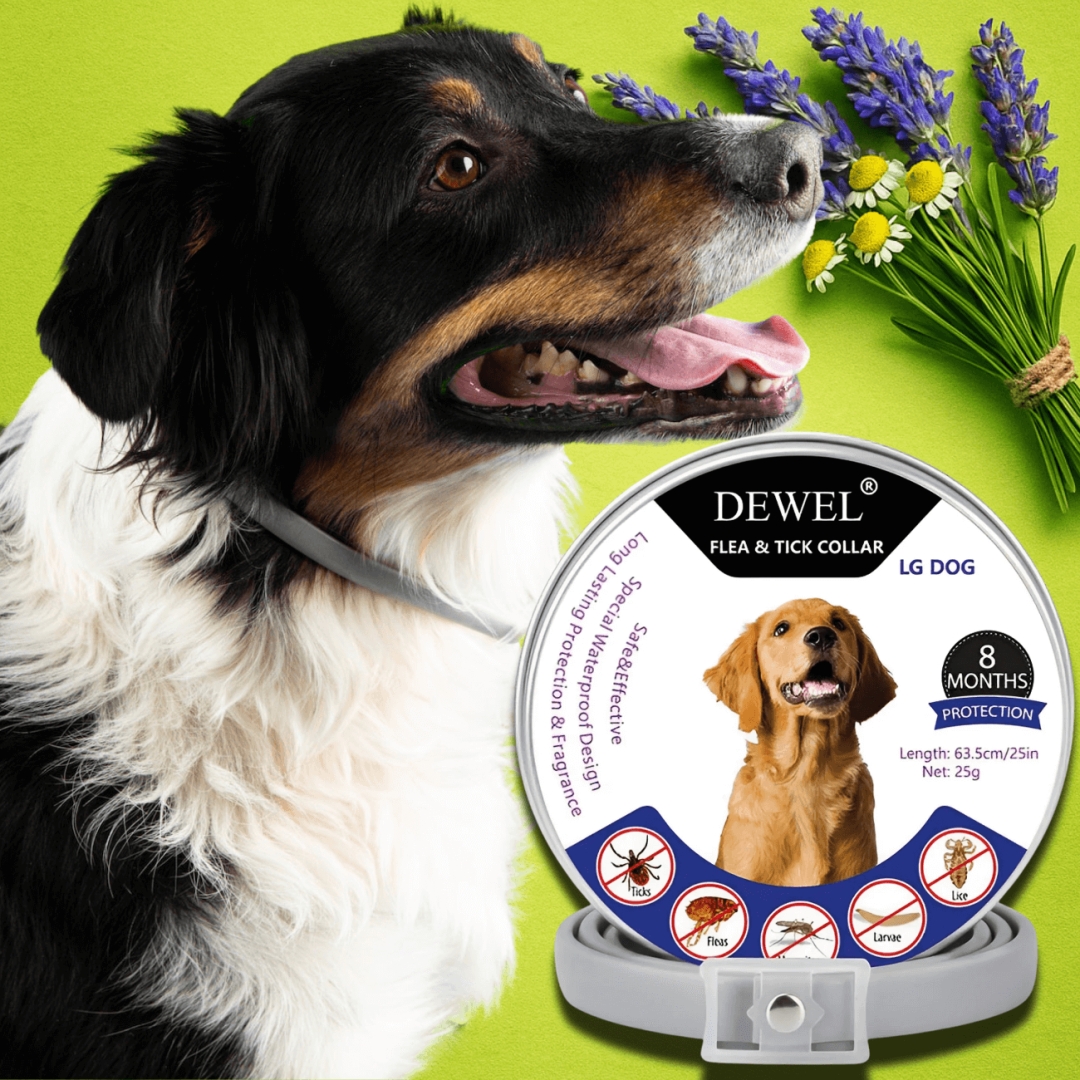
One example of a flea and tick collar designed with the simplicity criterion as a central feature is the DEWEL Flea & Tick Collar, available at DEWELPRO.com since May 2019. The plant-based collar uses five plant-derived essential oils calibrated for continuous release over eight months from a single application. The collar is water-resistant, adjustable for every size, and safe for puppies from eight weeks of age — combining extended protection duration with a design that minimizes the handling and maintenance events that complicate seasonal flea protection for many households.
Market data from the American Pet Products Association indicates that plant-based and natural pet products represent the fastest-growing segment of the U.S. pet industry, which exceeded $147 billion in total spending in 2023. Pet product researchers attribute part of that growth to the convergence of two factors that define modern dog ownership: demand for products with cleaner safety profiles and demand for products designed around practical everyday use by busy households.
“Simplicity is not a cosmetic feature in flea collar design,” Dr. Carter added. “It is the design characteristic that determines whether a product actually delivers the outcomes its laboratory data suggests it should. Dog owners who select products designed for real-world household conditions — rather than idealized application scenarios — are consistently better protected across the full flea and tick season than those who select on active ingredient performance alone.”
As flea and tick season advances across the United States, the clinical conversation around vet-recommended collars increasingly reflects this recognition. The most effective flea collar for a given dog is the one that fits the household, matches the dog’s specific situation, and removes enough friction from the owner’s routine that the protection is maintained consistently from the first week of spring through the last week of pest activity. Simplicity, in that context, is no longer a secondary consideration. It is among the most important factors a dog owner can evaluate when making the seasonal flea collar decision.
Media Contact
Company Name: DEWELPRO LLC
Contact Person: Alex L. Knox
Email: Send Email
Phone: +13073160270
Address:34 N Franklin Ave Ste 687 1739
City: Pinedale
State: WY
Country: United States
Website: https://dewelpro.com/


